
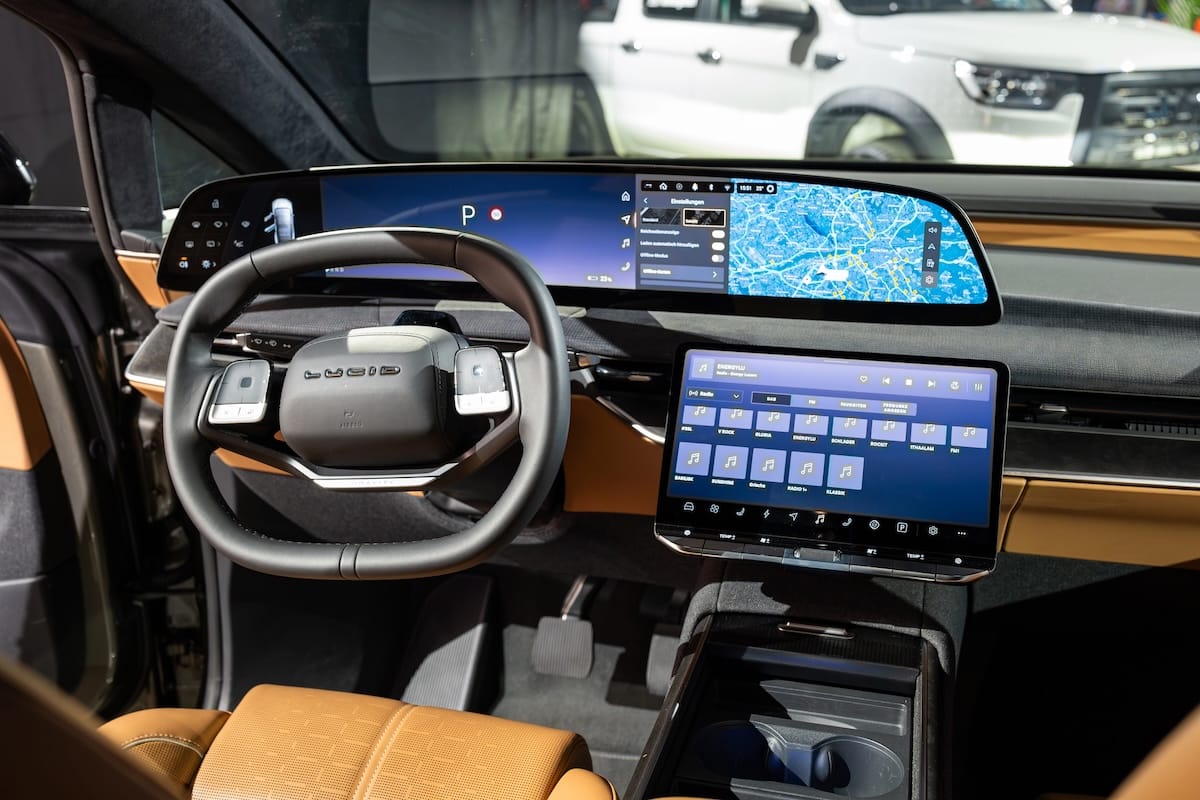
Is your Lucid Gravity spending more time in service than in your driveway?
California drivers who bought or leased a Lucid Gravity and cannot get it repaired may be entitled to a full buyback, a replacement vehicle, or a cash settlement under California’s lemon law.
The Gravity is Lucid’s first SUV, and it arrived on a brand new electrical and software architecture. Early build vehicles have generated three federal safety recalls, a delivery stop, and a growing volume of owner reports describing vehicles that will not start, will not shift, or will not stay repaired.
California is at the center of this. Lucid is headquartered in Newark, California, sells directly to consumers through its own studios and service centers, and operated 15 studio and service locations across the state as of late 2025. California accounted for 1,315 Lucid registrations in the first quarter of 2026, roughly 42 percent of the company’s global deliveries for that quarter.
A new lawsuit describes what Gravity ownership can look like
On August 18, 2026, a comedian and voice actor sued Lucid Group USA, Inc. in Middlesex County Superior Court in Massachusetts over a 2026 Gravity Dream Edition he leased in September 2025. The complaint offers an unusually detailed month by month account, and it alleges:
- A third-row seat that did not work at delivery, was repaired weeks late, then failed again
- Repeated no start events with blank display screens, including one that left the driver and his son stranded within days of delivery
- Persistent failures of the vehicle to recognize the key fob, with service personnel suggesting that he shake the fob, and key cards and the interior card reader that did not work either
- A two-day failure to start while the family was in rural Maine, followed by a tow that took three to four days to arrive and a promised rideshare that never came
- The accelerator pedal ceasing to function on the highway in the rain, accompanied by a red instruction to pull over immediately
- A defective low voltage junction box that was replaced, after which the replacement junction box also failed
- Driver assistance that disengaged without warning while the vehicle was moving, rear cameras that failed after an over the air update, a vehicle that would not shift into reverse in the middle of a street, and a front trunk that failed across three repair attempts
- More than 30 days out of service across multiple repair visits, a final repair demand that went unanswered, and a consumer protection demand letter that drew no reasonable settlement offer
The complaint also alleges that while his own Gravity was in for repairs, the plaintiff was seriously injured in a March 31, 2026, collision in a Lucid Gravity loaner. Two months later, he received a recall notice about a potentially nonconforming weld on a second-row seat bracket.
That case was filed under Massachusetts law. California’s protections are stronger.
No consumer class action has yet been filed on behalf of Lucid Gravity owners. The class actions filed against Lucid to date are securities cases brought by shareholders over the disclosure of the delivery disruption, not claims on behalf of the people who bought and leased the vehicles. That may change as more owners come forward, and California owners do not need to wait for it, because an individual lemon law claim can deliver a full buyback plus attorney fees on its own.
Three recalls in under a year
The Gravity has been the subject of three recall campaigns since it began reaching customers:
- Front seat backrest covers. A late 2025 campaign covered a small number of 2026 Gravity SUVs that may have received mismatched seat cover labels during production, which could cause the front side airbags to deploy improperly in a crash.
- Rearview camera. A January 2026 campaign covered 2025 and 2026 Gravity vehicles running software older than version 3.3.20, where the rearview image may fail to appear when the driver shifts into reverse. That is a violation of the federal rear visibility standard. The remedy was delivered over the air.
- Second row seat belt anchors. In March 2026, Lucid recalled 4,476 Gravity SUVs built between December 2, 2024 and February 14, 2026 because the bracket holding the second row outboard lap belt anchor may have an insufficient or misplaced weld, which can fail in a crash. Federal regulators estimated that roughly 97 percent of the recalled population is affected. The remedy is a reinforcement bracket or, where that is not possible, a full seat replacement.
Lucid also halted Gravity deliveries for roughly 29 days in the first quarter of 2026 while it worked through a seat component problem.
What Gravity owners are reporting
Beyond the recalls, owners have publicly described a recurring cluster of problems: 12 volt battery drains that leave the vehicle completely dead and require a flatbed tow, proximity unlock and key fob recognition failures, frozen or rebooting screens, driver assistance features that quit without warning, connectivity dropouts, and long service holds waiting on parts.
In April 2026, one Gravity Dream Edition lessee reported obtaining a full repurchase through BBB Auto Line arbitration after a seizing rear drive unit, recurring steering errors, and total key fob recognition failures. He reported that his vehicle had been out of service far longer than 30 days and that Lucid had refused a buyback until an arbitrator ordered one.
Arbitration is not the only route. Lucid’s order agreement contains an arbitration provision and a class action waiver, but it also gives buyers a limited window after signing to opt out of it. Consumers who opted out of that provision may be able to file a civil claim in court instead, where a judge or jury can award civil penalties and order Lucid to pay their attorney fees.
Your legal rights as a California consumer
The Song-Beverly Consumer Warranty Act, California Civil Code sections 1790 and following, is the strongest lemon law in the country. Its core promise is simple:
If the manufacturer or its representative in this state is unable to service or repair a new motor vehicle . . . to conform to the applicable express warranties after a reasonable number of attempts, the manufacturer shall make restitution in an amount equal to the actual price paid or payable by the buyer, including any charges for transportation and manufacturer installed options actually incurred by the buyer.
Leases are covered. Civil Code section 1795.4 extends these protections to consumers who lease rather than buy, which matters because a large share of Gravity vehicles were leased.
What counts as a reasonable number of attempts? California law creates a presumption in your favor if, within the first 18 months or 18,000 miles, any of the following is true:
- The same problem has been subject to repair four or more times
- The problem is likely to cause death or serious bodily injury and has been subject to repair two or more times
- The vehicle has been out of service for repair for a cumulative total of more than 30 days
That is a presumption, not a ceiling. Claims can still succeed outside those numbers. A no start defect, a loss of propulsion, a seat belt anchor that may not hold in a crash, and a driver assistance system that disengages at speed are all the kind of defects that go to use, value, and safety.
The remedies are substantial. A qualifying consumer can recover the price paid or payable including collateral charges, less a mileage offset for use before the first repair visit. A court can add a civil penalty of up to two times actual damages where the manufacturer’s failure was willful. Civil Code section 1794(d) requires the manufacturer to pay a prevailing consumer’s attorney fees and costs, which is why these cases cost you nothing out of pocket.
Depending on the facts, Gravity owners may also have claims for breach of express and implied warranty, violations of the federal Magnuson-Moss Warranty Act, and claims under California’s Consumers Legal Remedies Act and unfair competition law where a manufacturer sold or leased vehicles with defects it already knew about.
Lucid’s basic new vehicle warranty runs 4 years or 50,000 miles. Which track applies to your vehicle, and how long you have, are the first questions to answer. Do not wait to find out.
Lucid vehicles carry a manufacturer’s warranty, and California law holds the manufacturer to it. If your Gravity keeps going back to the service center for the same failures or has been out of service for weeks at a time, you may be entitled to your money back. The attorneys at the Consumer Law Group of California have litigated automotive warranty, defect, and consumer fraud cases for decades. A conversation about your repair history costs nothing and will tell you quickly whether you have a claim worth pursuing.
Tell us about your Lucid Gravity
A California consumer attorney will review your repair history and tell you whether you have a claim.